Every great song has a story behind it. Some songs are written in a flash of inspiration. Others take years to find their final form. Some songs are the work of a single person, while others come together through unexpected partnerships between people who have never even met. “America the Beautiful” belongs to this last category. It is one of the most beloved patriotic songs in the United States. Many people even believe it should be the national anthem instead of “The Star-Spangled Banner.” The song is played at important events, sung at schools, and performed at sports games. Its words are known by millions of people across the country and around the world. But who actually wrote those beautiful words? And how did the song come to be? The story takes us back more than one hundred years to a summer day on a mountain in Colorado, and it involves a poet, a composer, and a moment of breathtaking inspiration.
The Song Itself
“America the Beautiful” is a song that celebrates the natural wonders of the United States. When you listen to the words, you can almost see pictures in your mind. The lyrics talk about “purple mountain majesties,” which are tall mountains that look purple when the light hits them just right. They mention “amber waves of grain,” which are fields of golden wheat swaying in the wind. There is also the “fruited plain,” a description of the rich farmland that grows food for the nation. And finally, the song speaks of “shining sea,” meaning the bright and beautiful oceans on both sides of the country.
But the song is not only about nature. It is also about hope and goodness. In the song, the writer asks God to bless America and to help the country become a place of brotherhood, where people treat each other with kindness and respect. The song is like a prayer set to music. It expresses a wish for the country to be beautiful not just in its landscapes but in its heart and spirit. This combination of patriotism and prayer has made the song endure for well over a century.
The Lyricist: Katharine Lee Bates
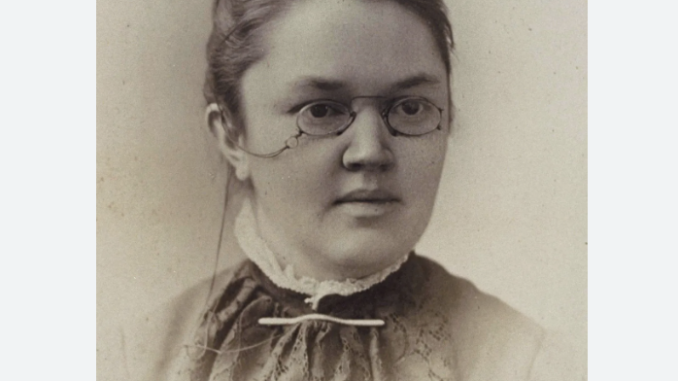
The words to “America the Beautiful” were written by a woman named Katharine Lee Bates. She was born on August 12, 1859, in Falmouth, Massachusetts. Her father was a minister, and her mother was a teacher. From a very young age, Bates loved reading and writing. She was a curious and intelligent child who asked many questions about the world. She went to school and then to college, which was not always common for women at that time. She worked very hard and eventually became a professor of English literature at Wellesley College in Massachusetts.
Bates was a poet, an author, and a teacher. She wrote many poems and books during her lifetime. She believed that words had the power to change the world. She was also a person who loved to travel and see new places. She believed that experiencing the beauty of nature could inspire great art and deep thoughts. She was not a songwriter by trade. She was a poet who loved her country and wanted to express that love in the most beautiful way she could.
The Composer: Samuel A. Ward
While Bates wrote the words, the music for “America the Beautiful” came from a completely different person. His name was Samuel A. Ward. He was born in 1848 in Newark, New Jersey. He was a church organist and choir director. He loved music from a young age and dedicated his life to it. In 1882, Ward composed a melody for a hymn called “Materna.” The word “Materna” comes from Latin and means “motherly.” The melody was beautiful and uplifting, and it fit well with religious hymns.
Ward probably never imagined that his tune would one day become attached to a patriotic song about America. He wrote the music for a religious purpose. But fate had other plans. Years after his death, his melody would find its perfect partner in Bates’s words.
The interesting and slightly sad part of this story is that Katharine Lee Bates and Samuel A. Ward never met each other. They lived in different states. Ward died in 1903, years before his music was officially paired with Bates’s poem. He never knew that his melody would become famous all over the country. The poet and the composer, working independently and never crossing paths, together created something timeless.
The Story Behind the Lyrics
Now we come to the most exciting part of the story. How did a poetry professor from Massachusetts come to write the words to one of the most famous songs in American history? It all started with a trip.
In the summer of 1893, Katharine Lee Bates was teaching at a summer school in Colorado Springs, Colorado. She had traveled from the East Coast to the West, which was a long and difficult journey at that time. There were no airplanes. People traveled by train, and the trip took many days. Bates was excited to see the American West, which was very different from her home in Massachusetts.
One day, Bates and some friends decided to take a trip to the top of Pikes Peak. Pikes Peak is a very tall mountain in the Rocky Mountains. Its summit is over fourteen thousand feet above sea level. That is very high. The journey to the top was not easy. There were no cars or buses that could drive up. Bates and her group had to ride in a wagon for part of the way. Then they switched to riding on mules, which are animals similar to horses but better at climbing steep and rocky paths. The ride was bumpy and a little scary. But Bates was determined to reach the summit.
When she finally stood at the top and looked out at the view, she was amazed. The sky was a brilliant blue. The plains below stretched out like an endless golden sea. The other mountains in the distance looked purple against the horizon. Everything was still, silent, and incredibly beautiful. Bates later wrote about this moment. She said, “It was then and there, as I was looking out over the sea-like expanse of fertile country spreading away so far under those ample skies, that the opening lines of the hymn floated into my mind.”
The words came to her almost fully formed. Standing on top of that mountain, she felt like she could see the whole country at once. The beauty overwhelmed her, and her heart responded with poetry. She quickly wrote down the words before they could slip away. The poem she began that day would eventually become “America the Beautiful.”
How the Poem Became a Song
Bates did not originally write the poem to be a song. She wrote it as a poem and called it simply “America.” The poem was first published in a weekly newspaper called The Congregationalist on July 4, 1895. That date is very important. July 4 is Independence Day in the United States, the day the country celebrates its freedom. Publishing a poem called “America” on that day was very fitting.
People loved the poem immediately. It captured something deep and true about the feeling of being American. Newspapers all over the country reprinted it. The poem was shared in churches, schools, and homes. But there was no music attached to it yet. Bates herself revised the poem several times over the years. She changed words, added lines, and polished it until it was exactly right. The final version we sing today was mostly completed by 1913, twenty years after that day on Pikes Peak.
Meanwhile, different musicians tried to set the poem to music. Several melodies were written for it, but none of them stuck. Then, in 1910, someone had the idea to pair Bates’s words with Samuel A. Ward’s melody from “Materna.” The combination was perfect. The sweeping, uplifting music matched the grand and hopeful words. The song became immediately popular and eventually became the version everyone knows.
What the Lyrics Mean
Let us look more closely at the words of the song and what they mean. Each verse paints a picture and expresses a hope.
The first verse is all about the physical beauty of America. “Purple mountain majesties” are the tall, proud mountains like the one Bates climbed. “Amber waves of grain” are the golden wheat fields that grow in the middle of the country, waving in the wind like ocean waves. “Fruited plain” describes the rich farmland that produces fruits, vegetables, and other food. “Shining sea” refers to the Atlantic and Pacific Oceans on the eastern and western coasts, sparkling in the sunlight.
The second verse is about people. It describes pilgrims, heroes, and those who built the country. It celebrates the hard work and sacrifice of those who came before.
The third verse looks to the future. It expresses a hope that America will become even better. It asks God to help the country improve, to heal its flaws, and to guide its people toward goodness.
The final verse is a prayer for the future. It asks for brotherhood from sea to shining sea. Bates wanted a country where people treat each other like brothers and sisters. She wanted a nation united not just by land, but by love and kindness.
Interesting Facts
There are many interesting facts about “America the Beautiful.” Katharine Lee Bates was not paid for writing the poem. She simply gave it to the newspaper for free. She never expected it to become famous. She was just a poet expressing her feelings.
Bates was also a woman who believed strongly in equality and justice. She cared deeply about making the world a better place for everyone.
Samuel A. Ward, the composer, never knew his music would become attached to such a famous song. He died seven years before the official pairing in 1910.
The song has been performed by countless artists over the years. Ray Charles, a legendary singer, recorded a version that became very famous. Many people consider his soulful rendition to be one of the most moving performances of the song.
There have been many attempts over the years to make “America the Beautiful” the official national anthem of the United States instead of “The Star-Spangled Banner.” Supporters say it is easier to sing and has a more peaceful and hopeful message. So far, these attempts have not succeeded. But the debate continues, and the song remains deeply loved.
Conclusion
“America the Beautiful” is a song born from a single breathtaking moment. In 1893, a poetry professor stood on top of a mountain in Colorado and was so moved by the beauty of her country that words came pouring out of her. Those words, written down quickly and later revised with care, became one of the most beloved poems in American history. Years later, those words were set to music written by a church organist who had died before he could ever know the impact his melody would have. Together, without ever meeting, Katharine Lee Bates and Samuel A. Ward created a song that has inspired millions.
The next time you hear “America the Beautiful,” remember the story behind it. Remember the poet on the mountain, the composer at his organ, and the hope they shared for a country filled with beauty, both in its land and in its people.
Rating: A timeless masterpiece with a beautiful story behind it, 10 out of 10 stars.