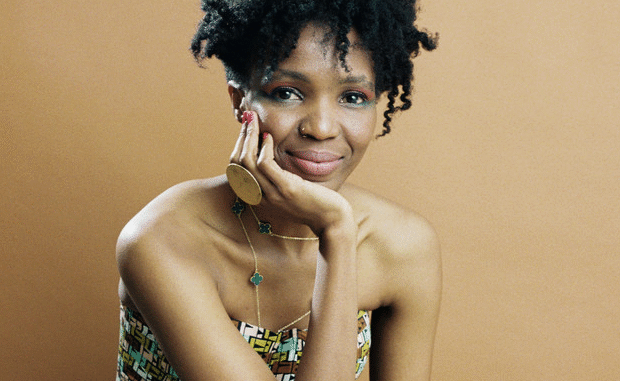
Born in Soshanguve, Pretoria, Thandi Ntuli is one of the most progressive and emotionally conscious South African contemporary jazz pianists, singers, and composers. She has earned herself a reputation as a fearless sonic journeyist whose music incorporates jazz, African spirituals, classical education and training, experimental improvisation and personal narratives that are highly personal. Within the past ten years, she has become one of the most creative musicians of her era who has challenged the limits of what South African jazz should be and still she has been connected to the memory, tradition and self-reflection. Not only is her sound an art form but it is an emotive language, soft, probing, expansive, and unmistakably hers.
Thandi was exposed to influence of art at a tender age as she grew up in a family with a rich musical heritage. Her uncle was the great guitarist Selby Ntuli of the Harari as one of the most influential Afro-rock groups of the 1970s in South Africa. Thandi started with formal education early in life when she was taught classical piano, which gave her a good ground in terms of technical skills as well as an early understanding of the importance of discipline, theory and the emotional aspect of music.
She became interested in experimenting with sound as she grew older and was no longer in the structure of classical. This drew her into jazz-genre, which provided freedom, improvisation and self-expression without neglecting technical mastery. She continued with formal studies in jazz after high school involving herself in theory, composition and performance. It was during this period that she could find her voice as not just an instrumentalist but also as a conceptual theorist capable of creating narratives, memories and feelings about each note.
During her entry into the jazz arena of South Africa, Thandi was accompanied by a combination of influences that remained unparalleled: gospel, soul, township songs, contemporary jazz, experimentation and African folk memory. Her style became a subtle combination of intimacy and exploration- gentle but deliberate and self-reflective yet full of the harmonious richness. Her piano playing was more sensitive than showbiz. Rather than exploitative show displays in virtuosity, she preferred melancholy, space and connection, which resulted in a calm conversation between the heart and the mind through the music.
Her first album The Offering was published in 2014, and this album became a breakthrough in her career. The album presented her as a performer with an extraordinarily mature tone- some one who is not afraid to experiment with identity, femalehood, spirituality as well as vulnerability of emotions. Its combination of African rhythms of language, harmonies, and poetry appealed to the listeners. The album was met with generational critical success and made Thandi one of the brightest names of the jazz renaissance in South Africa. It also led to festivals, scattering as well as an expanding international footprint.
As her artistry developed she kept pushing her sonic limits. She started to incorporate voice in her works, not as a lead voice but as another instrument, which conveyed emotion, texture and story. Her live shows were characterized by the closeness and immersion, which could be defined as curative, meditative, and touching. She often incorporated spoken word and chant-like singing and improvisation to produce living breathing performances which do not conform to conventional jazz styles.
Another significant change occurred in her 2018 project EXILED. The album was a profoundly introspective, emotionally charged study of individual and group displacement, belonging, trauma and healing. It was constructed on expansive schemes, tortured singing, overlapping harmonies and a sound palette, which alternated between modest minimalism and confident experimentation. EXILED received a great acclaim due to its emotional richness and conceptual bravery and established Thandi as one of the most innovative voices in contemporary South Africa. The project not only appealed to the audiences of the traditional jazz, but also to people of other genres who could relate to the project due to its honesty and psychological integrity.
Along with her solo work, Thandi is now a sought-after collaborator. She is a strong personality in group performance due to her musical intellect and emotional sensitivity. She has collaborated with artists in the fields of jazz, soul, classical, electronic and African experimental music. This has seen her work with Nduduzo Makhathini, Marcus Wyatt, Sibusile Xaba, Shabaka Hutchings, Somi, The Brother Moves On, and dozens more without taking away from her essence. She is the source of not just technical competence in any of her collaborations, but also of an instinctive sense of mood and narrative.
Thandi is also experimental in multidisciplinary work. She has worked with dancers, visual artists, film directors, as well as theatre practitioners and employed sound as the medium of storytelling and feeling in various art genres. She also uses workshops, residencies and education programs to inform her interest in healing, spirituality and memory. She is considered by many new artists as a role model who helps them to be vulnerable and authentic in their artistic endeavors.
Her sound has been referred to as spacious and atmospheric. She employs silence strategically where she lets silence to enhance emotional appeal. Her melodious language is flowing, incorporating the complexity of jazz and the African melodic pattern, as well as the classical accuracy. Her music seems like half-finished dialogues – open, exploring, personal. This feature shows her philosophy of art: music is the process, a journey, the reflection of the moment and not the final solution.
Despite having an international audience, Thandi is still connected to the South African cultural and musical world. Most of her work is riddled with themes of the South African identity: healing of a collective trauma, the need to navigate modernity using the memory of the ancestors, retrieving African stories, and the spirit of the feminine. Her writing and acting have an emotional sincerity that is seldom encountered in any and all backgrounds and generations.
Today Thandi Ntuli is regarded as one of the most critical creative voices of the contemporary African music. Her works have contributed towards a new generation of South African jazz that is more experimental, introspective and spiritual. She keeps evolving her sound with each new project and experimenting with different textures, different feelings, and different approaches to audiences. Her songs beckon the audience into a world of thought, sensitivity, and aestheticism- to a world where music is a healing process. The legacy of Thandi is still being played out, but she has already made a name of herself as a visionary artist whose influence will keep expanding even during her later years.
Here are the song titles
- Lihlanzekile
- The One – Second Part
- The One – First Part
- Voice and Tongo Experiment
- Piano Edit
- Breath and Synth Experiment
- Rainbow Revisited
- Sunrise (In California)
- Sunset (In California)
- Nomayoyo (Ingoma ka Mkhulu)
- No Wrong Turn
- Secret Keeper
- Go Gently As The Sower Reaps
- Portal Into A New World
- Amazing Grace
- Cold Winds
- Izibongo
- Inkululeko
- Dikeledi
- Rainbow – Live
- Rainbow (Shane & Rico’s Intro) – Live
- Portal – Live
- New Way – Live
- Setting the Tone for Exile – Live
- Cosmic Light
- 13
- New Way
- Rainbow – Skit
- It’s Complicated, Pt. 2
- It’s Complicated, Pt. 1
- The Void
- Umthandazo Womzali
- What’s Left?
- Abyssinia
- Abyssinia – Intro
- Freefall
- Exiled
- The Void – Intro
- Cosmic Light
- Cosmic Light (Benji’s Meditation)
- In Between Spaces
- Love Remembers
- Sangare
- The Offering
- H.T
- Uz’ubuye
- Uz’ubuye – Intro
- Umthandazo
- 201 AA
- Contemplation
- Lonely Heart