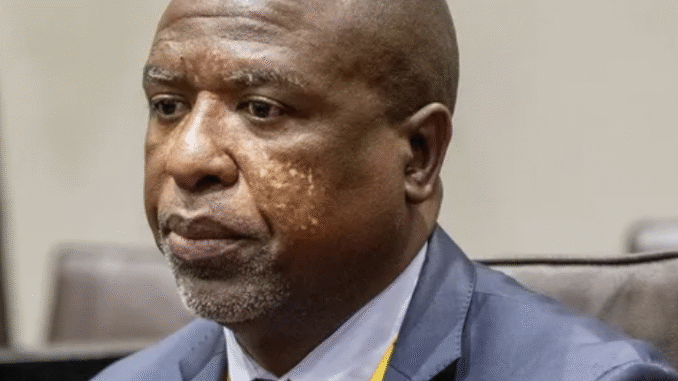
South African politics, a place where alliances are made and broken as easily as the sands begin and end, Molapi soviet Lekganyane has gained the admiration of being something exceptional; a still, disciplined and highly tactical player. He is neither the most provocative nor the most vocal. However, when the African National Congress (ANC) had to find a person to bring order in the Limpopo province, which had a bad reputation of internal wrangles, Lekganyane was called. Twice. His days of walking over 10 kilometers to school in rural Turfloop as a child to his membership in the National Assembly as a Member of Parliament are years of his life full of dedication, perseverance and a determination not to be deterred in serving the people. This is his story.
Who is Soviet Lekganyane?
Molapi soviet Lekganyane was born on April 18, 1974, in Turfloop, Limpopo Province that is full of cultural history and political activism, yet full of poverty and underdevelopment. His given name, Soviet, is a strange name of a South African politician, but it was an appropriate name of his time, the peak of the cold war when the soviet Union was considered by most anti-apartheid activists as an ally in their battle against white-minority rule supported by Western powers.
Even now, decades after the apartheid, Lekganyane was growing up in a village that is still underdeveloped. His own description shows that his village has a single tarred main road and a small primary school as the only governmental facility. It has no secondary school, no health care clinic, and no community hall” He had to walk more than 10 kilometers a day in an attempt to accomplish his secondary education after the completion of primary education and this exercise would introduce him to the disparities that have bedeviled South Africa.
The irony around this deprivation, as Lekganyane later came to appreciate, was that the university of Limpopo, a good institution of high learning, was within walking distance of his village. He termed it A burning beacon of hope set against a backdrop of endemic deprivation. This was the difference between what could be and what was, and this was the drive behind his political awakening.
Lekganyane grew up in a highly politically conscious and youth movement atmosphere in the hurly-burly of the last years of apartheid. It was a period where some radical figures like Peter Mokaba, among others emerged; they were giants in the ANC whose sacrifices in the struggle made a permanent scar on him. He is lucky to have been personally involved in working with such leaders whose oratory, tact and commitment to justice assist in shaping his political perspective.
Conjecture There has been speculation that Lekganyane is the grandson of Barnabas Lekganyane, the renowned head of the Zion Christian Church (ZCC), which is one of the largest religious bodies in the Southern part of Africa. Nonetheless, the information that verifies any family relation is not verified. The family name is not unique in Limpopo, but the politician is not known to be related to the church leader.
Education: Preparation of Leadership.
Lekganyane was aware at a young age that education was his key to a life outside the poverty trap and into a job whereby he would be able to make some difference. He did not rely on charisma like most politicians, but instead attained several degrees, which would make him a formidable academic portfolio, which would prove useful in the governance.
The University of South Africa (UNISA) which is the largest distance learning institution in the country awarded all his degrees. This constitutes a lot since it meant that he was working and in his studies at the same time, organizing, climbing the political ladder. It addresses an area of study that his fellow academics have mentioned as his hallmark.
The Politics of Ascent: Communism to provincial dominance.
The political journey of Lekganyane did not take the ANC as the immediate political party, but the affiliate of the ideological party, the South Africa Communist Party (SACP) . This is a natural step among most ANC leaders; the SACP has been a breeding pool of cadres who cherish ideological correctness and organization.
The SACP Years (2008-2011)
Lekganyane rose to prominence as the Provincial Secretary of the SACP’s Limpopo branch, serving from August 2008 to March 2011 . He was also appointed as Provincial Coordinator of the Young Communist League (YCL) in Limpopo, the youth wing of the SACP, where he helped significantly raise the party’s profile in the province.
His time in the SACP was not without controversy. In early March 2011, Lekganyane resigned from his position as SACP Provincial Secretary, publicly stating that his relationship with the party had broken down . He claimed that the national leadership of the SACP had become overly invested in leadership battles within the ANC, had targeted the Limpopo branch because of its close relationship with the provincial ANC Youth League and Julius Malema (then a powerful but controversial figure), and had pressured him as Housing MEC to award state contracts to SACP comrades .
The SACP responded harshly, publicly disowning his claims as a “campaign of lies, slander and malicious distortions intended to inflict maximum damage and to create confusion within the ranks of the SACP and beyond” . This public break was rare and messy, but it did not derail Lekganyane’s career. Instead, it freed him to focus entirely on the ANC.
MEC for Local Government and Housing (2009-2012)
While still a member of the SACP, Lekganyane had already entered government. In May 2009, following the general election, the newly elected Premier of Limpopo, Cassel Mathale, appointed Lekganyane to his Executive Council as the Member of the Executive Council (MEC) for Local Government and Housing . He succeeded Maite Nkoana-Mashabane, who would go on to become a national minister.
This was a massive responsibility for a relatively young politician. Local government in South Africa is often described as the “coalface” of service delivery–the sphere of government closest to the people, but also the one most plagued by dysfunction, corruption, and capacity issues. Housing, too, was (and remains) a flashpoint, with millions of South Africans still waiting for the decent homes promised by the democratic government.
Lekganyane served in this role until March 2012, when he resigned to take up a full-time position within the ANC’s provincial leadership . His time as MEC gave him valuable executive experience and a track record he could point to when seeking higher office.
Two Terms as ANC Provincial Secretary (2011-2013 and 2018-2022)
The position of Provincial Secretary of the ANC in Limpopo is one of the most powerful political posts in the province. The secretary controls the party machinery–the organization, the discipline, the logistics of conferences and elections. In a province where the ANC has dominated for decades, controlling the party means controlling Limpopo.
First Term (2011-2013): The Mathale Years
In December 2011, at the ANC’s provincial elective conference, Lekganyane was elected Provincial Secretary, winning a tight race against the incumbent, Joe Maswanganyi. He received 601 votes to Maswanganyi’s 517–a victory of about 90 votes . He ran on a slate aligned to Premier Cassel Mathale, who was simultaneously elected Provincial Chairperson.
This was a high-stakes period in Limpopo politics. Mathale’s faction was closely associated with Julius Malema, then the firebrand leader of the ANC Youth League, who was increasingly at odds with national ANC leadership under President Jacob Zuma. At the ANC’s 53rd National Conference in December 2012, Lekganyane and the Limpopo delegation supported Kgalema Motlanthe’s unsuccessful bid to unseat Zuma as ANC President .
The aftermath was brutal. In March 2013, the national ANC leadership disbanded the entire Limpopo Provincial Executive Committee, accusing provincial leaders of displaying “totally un-ANC behaviour and institutionalised factional conduct” . Lekganyane’s term as Provincial Secretary ended prematurely, a casualty of the factional wars that have long plagued the ANC.
Despite this setback, Lekganyane remained loyal to the ANC. In June 2013, he publicly disowned his former ally Julius Malema–by then expelled from the ANC–and Malema’s new party, the Economic Freedom Fighters (EFF) , which Lekganyane dismissed as a “libertine initiative” .
Provincial Legislature and Finance Chair (2014-2018)
After the disbandment of the provincial leadership, Lekganyane regrouped. In the 2014 general election, he was listed 31st on the ANC’s provincial electoral list and won a seat in the Limpopo Provincial Legislature . During his four-year term, he served as Chairperson of the Legislature’s Finance Committee, a role that allowed him to scrutinize provincial spending and hold the executive accountable.
This period also saw him briefly campaign for a return to the Provincial Secretary position. In late 2013, he was named as part of a slate aligned to Dickson Masemola, who intended to challenge Stan Mathabatha for the party chairmanship . However, when the provincial elective conference was finally held in February 2014, both Lekganyane and Masemola withdrew from contention, and Nocks Seabi was elected Provincial Secretary instead .
Second Term (2018-2022): The Mathabatha Years
Lekganyane’s political resurrection came in June 2018. At the next provincial elective conference, held in Polokwane, he stood again for Provincial Secretary–this time against the backdrop of a very different political landscape. Cyril Ramaphosa had replaced Zuma as national president, and Stan Mathabatha had succeeded Cassel Mathale as Premier and ANC Provincial Chairperson.
The SACP opposed Lekganyane’s candidacy, publicly stating that he had a poor record as a leader both in the ANC and in the SACP . But Lekganyane had clearly rebuilt his networks. He won the election decisively, beating ANC Youth League Provincial Chairperson Lehlogonolo Masoga with 931 votes to 618 .
In the aftermath of his election, Lekganyane gave an interview to the Mail & Guardian in which he argued that the ANC should pursue an aggressive anti-corruption campaign ahead of the 2019 general election. In particular, he supported taking action against ANC politicians implicated in the VBS Mutual Bank scandal, a massive looting operation that had devastated municipalities across Limpopo and surrounding provinces . This was a bold stance, given that many of those implicated were his fellow ANC members.
The Assault Allegation (2021)
During his second term, Lekganyane faced a serious personal controversy. On June 5, 2021, during an ANC branch meeting in Polokwane, an argument broke out over the nomination of candidates for the 2021 local government elections. A fellow ANC member alleged that Lekganyane assaulted him, “grabbing me by my private parts” and saying “today I’m going to kill you” .
The complainant opened a case of sexual assault against Lekganyane and his alleged accomplices. In turn, Lekganyane and the others opened a case of malicious property damage against the complainant, whom they accused of damaging equipment during the scuffle . As of 2026, the outcome of these cases has not been publicly reported. Lekganyane has not been convicted of any crime related to the incident.
Losing the Third Term (2022)
Ahead of the expiry of his term in June 2022, Lekganyane ran for re-election to a third term as Provincial Secretary. However, he had lost favour with Premier Stan Mathabatha’s camp, which perceived him as having betrayed them in order to gain favour with the allies of President Cyril Ramaphosa .
Lekganyane ran against Reuben Madadzhe, and lost decisively: Madadzhe received 714 votes to Lekganyane’s 451 . It was a significant defeat, and it marked the end of his tenure as the top party administrator in Limpopo.
The Rise to National Politics (2022-Present)
Losing the Provincial Secretary position might have been the end of the road for many politicians. But Lekganyane had already set his sights on the national stage.
Election to the National Executive Committee (2022)
In December 2022, just months after losing his provincial post, the ANC held its 55th National Conference at Nasrec, Johannesburg. Lekganyane stood for election to the party’s National Executive Committee (NEC) , the highest decision-making body between conferences .
The results were stunning. Lekganyane was elected to a five-year term on the NEC, ranked 17th out of 80 candidates–a remarkably high position. He received 1,653 votes out of the 4,029 ballots cast, placing him above many far more famous politicians . This demonstrated that, despite losing at the provincial level, he retained significant support nationally.
Key NEC Appointments
Following his election to the NEC, Lekganyane was given several important roles:
Deputy Chairperson of the ANC National Dispute Resolution Committee, serving under chairperson Mduduzi Manana .
Member of the ANC National Disciplinary Committee of Appeal.
Head of the NEC’s delegation to the party’s provincial branch in the North West Province, a troubled province that has been under national administration multiple times .
Member of Parliament (2015-Present)
As a candidate of the ANC, Lekganyane appeared on a national electoral list of the party at the 15 th place in the May 2024 general election. On June 14, 2024, he was elected to a seat of the lower house of the South African Parliament (the National Assembly) and sworn into office.
The ANC declared that it was going to nominate Lekganyane and Fasiha Hassan to the Parliament at Judicial Service Commission (JSC), where judicial nominations were interviewed and recommended. It is a very sensitive and powerful post, which puts Lekganyane in the centre of South African judicial governance.
On Constituency Offices
Lekganyane presented the argument that the Constituency Offices which are supposed to be impartial and public access to Parliament have become a political party and useless. He pointed out they are usually labeled with party names and with individual MPs instead of being recognized as non-partisan public facilities. Such branding is confusing to the citizens and it is demotivating them to participate as these offices are expected to serve the South Africans without regard to their political affiliations. He proposed that these offices should be re-packaged into official arms of Parliament so that they are more approachable.
On Oversight Visits
He took a similar critical stance over the manner in which the parliamentary committees carry out the oversight visits citing that they are sometimes shallow and not in touch with the communities. On such visits, as in the case of a project such as a school or a water facility, the committees tend to hold closed-door meetings with government departments or service providers. The project does not consult communities affected by the project and disregards their experiences. Parliament turns up in blue-light convoys, they have meetings in seclusion and they leave without consulting residents. Lekganyane demanded community voices to be represented in control and that debriefing of the people be made after the visits.
On Public Participation
Lekganyane also denounced the involvement of people in law-making as being weak and tokenistic. The majority of laws are written in the Executive and Parliament does not engage people in any form of masses observation until towards their final stages. Such hearings are in most cases too late and the citizens are not educated correctly on the bills or the legal concepts and thus when they contribute, they do so without any knowledge or information. This leads to laws that do not address the needs of the communities, decades after the start of democracy. According to him, Parliament ought to consult the people far earlier in the business of legislation.
On the Government of National Unity (GNU).
Lekganyane stated that he was a big proponent of the Government of National Unity established by the 2024 election, where ANC, which had lost its majority since 1994, formed a coalition with other various parties. His point was that the GNU was not only the only way to go but the best way to go in the direction of the stability, development, and the democracy of South Africa.
He cited the example of 1994 which saw the emergence of a GNU between ANC and IFP to stabilize KwaZulu-Natal which had in the past been marred with political violence. He observed that that peace enabled the province to grow and enhance its image in the country. He also held that a multi-party government also enhances a healthy check and balances–it is no-holds-barred, since the various parties can cross-examine and keep each other on their toes.
Privacy and Principle: A Man of Privacy.
Although there is a lot of the publicity about him, Soviet Lekganyane is a highly personal person. He already has a wife, yet the name of his wife has remained confidential. This is a deliberate choice. During a time when politicians in large numbers consider their families as a photo opportunity and sympathy voter Lekganyane has made a solid boundary between his duties as a politician and his personal life.
He is also a man of faith. Although he does not talk a lot about religion in public, those who know him talk of him as a man of high moral standards whose leadership is influenced by values of integrity, honesty and accountability.
His co-workers state that he is a calm, intelligent, and results-oriented person. His leadership approach is diplomatic and hard. He appreciates discipline, structure, and accountability- qualities that have made him earn admiration in the ANC and the South African politics at large.
Net Worth and Lifestyle
Precise net worth of Lekganyane is not released, which is standard of the South African politicians that are not business tycoons. His career in the government and his activities in the ANC contribute to most of his incomes. According to the political analysts, his financial position is moderate, as it is the case with other senior parliamentarians in South Africa.
He is a humble and disciplined person and is known to live a lifestyle that is close to the Limpopo community, despite his success. He has preached vehemently with regard to how leaders must be prepared to go barefooted and abandon comfort in order to serve the people with importance.
Facts
In conclusion of a summary of soviet Lekganyane: Molapi soviet Lekganyane was born on April 18, 1974, in Turfloop, Limpopo, which means that as of 2025, he is 51 years old. He was brought up walking as much as 10 kilometers to attend school in a village that even does not have the basic facilities such as secondary school or clinic. He has a Diploma in Secondary Teaching, Bachelor of Laws (LLB), Bachelor of Political Science, Postgraduate Diploma in Leadership and Public Management at the National School of Government and is pursuing a Degree course in Governance and Public Management at Stellenbosch University. He was also an outstanding Provincial Secretary of SACP Limpopo in 2008-2011 and MEC of Local Government and Housing in 2009-2012. He has worked as ANC Provincial Secretary in Limpopo with Cassel Mathale serving as deputy to him in 2011-13 and under Stan Mathabatha in 2018-22. In December 2022, he was elected to the National Executive Committee of ANC, being ranked 17th among 80 applicants. In June 2024, he joined the National Assembly as a Member of Parliament. He is a married man, who does not disclose the name of his wife. In 2021, he was alleged to have sexually assaulted a woman during an ANC branch meeting, but the result of the outcome was not reported publicly. He is not reported as having any family relation to Barnabas Lekganyane of the ZCC. He is famed by his level-headed nature, his discipline, and the philosophical approach that the people need their representatives in Parliament to regain their trust by prioritizing the needs of the people. He has characterized his childhood village as an eye-catching representation of the opportunity in the context of unrelenting deprivation.
Conclusion: The Strategist’s Long Game
Soviet Lekganyane is not a flashy politician. He does not seek the spotlight. He does not give fiery speeches that go viral on Twitter. But he has outlasted nearly all of his contemporaries in the brutal arena of Limpopo politics. He has been fired, disbanded, and defeated–and yet he keeps rising.
His journey from walking 10 kilometers to school in Turfloop to sitting in the National Assembly is a testament to the power of education, discipline, and strategic patience. He has made enemies, certainly. His public break with the SACP, the assault allegation, and his role in the factional wars of the ANC will always be part of his record. But he has also been a consistent voice for anti-corruption, for parliamentary reform, and for the kind of humble, servant leadership that South Africa desperately needs.
As of 2026, Lekganyane serves in Parliament, sits on the ANC’s NEC, and represents the ANC on the Judicial Service Commission. He is not done yet. Whether he will rise further–perhaps to a national ministry or even higher–depends on forces that are impossible to predict in the ever-shifting landscape of ANC politics. But one thing is certain: Soviet Lekganyane will be in the room where it happens. And he will be the calmest, most disciplined person there.
He is not the loudest voice. But he is the one that endures.