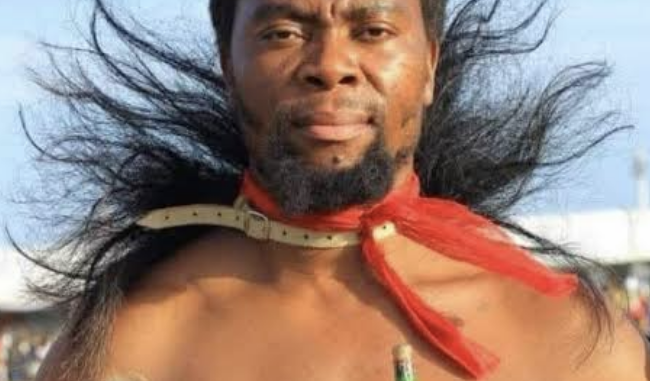
In the mid-2020s, a new movement emerged in South Africa that would dominate headlines, spark legal battles, and reshape the national conversation on immigration. March and March, together with traditional activist Nkosiikhona Ndabandaba, also known as Phakel’umthakathi, became the most visible faces of a growing wave of frustration over undocumented foreign nationals. Their marches through Durban, Johannesburg, Pretoria, and East London drew thousands of supporters and the backing of major political parties like ActionSA, the IFP, and the MK Party. But they also drew condemnation from human rights groups, the South African Human Rights Commission, and even President Cyril Ramaphosa. This is the story of the leaders behind the movement.
Who is Phakel’umthakathi?
Nkosiikhona Ndabandaba, known publicly as Phakel’umthakathi, is a Zulu cultural activist from Nongoma in KwaZulu-Natal. The name Phakel’umthakathi is a Zulu phrase that roughly translates to “feed the wizard” or “feed the sorcerer.” It is a powerful, provocative name that suggests a person who confronts dark forces or challenges witchcraft. In the context of his activism, the “wizard” he claims to be confronting is illegal immigration.
Ndabandaba rose to prominence as a co-leader of anti-immigration marches alongside Ngizwe Mchunu, the former Ukhozi FM host and self-declared president of the Amabhinca Nation. Together, they have led protests in Durban, KuGompo City (formerly East London), Pretoria, and Johannesburg, calling for the mass deportation of undocumented foreign nationals.
Ndabandaba has a strong traditionalist background. He claims to speak for rural Zulu communities that, in his view, have been neglected by the government and overrun by foreign nationals. He argues that black students at universities in Durban are victims of drugs distributed by people from other countries. “The communities I fight for have never seen a white person raping or killing their children,” he said in response to critics. “In Nongoma where I am staying, there is no white person who is in the country illegally who has come to own a tuckshop or a salon.”
Ndabandaba has also faced serious allegations. Sbu Zikode, the leader of the shack dwellers’ movement Abahlali baseMjondolo, publicly accused Ndabandaba of taking bribes to chase away black foreign nationals. Zikode claimed that Ndabandaba had recently bought a vehicle costing around R1.2 million as a bribe. Ndabandaba denied the allegation and hit back at Zikode, accusing him of defending criminals.
March and March: The Organisation
While Phakel’umthakathi operates as a traditional activist, March and March presents itself as a modern civic organisation. The movement was founded by Jacinta Ngobese-Zuma, a former radio presenter who worked at Gagasi FM and later at Vuma FM in Durban. The name “March and March” suggests rolling, continuous mass action – a movement that will not stop marching until its demands are met.
March and March describes itself as a civic organisation focused on protecting the rights of South African citizens. Its website uses the symbolism of South Africa’s civic sector, with T-shirts, marches, and campaigns all bearing the national flag. This branding is deliberate. It projects the image of a patriotic, mainstream civil society group rather than a fringe extremist organisation.
The movement’s first major protest was in Durban following a tragic incident in which eight-year-old twins Aphelele and Aphile Dlamini fell down an unsecured lift shaft at the Homii Lifestyle apartments in 2025. The protests took on an anti-foreigner sentiment because the building may have been owned by non-South Africans. This pattern became typical of March and March: taking a legitimate community grievance and framing it as a problem caused by undocumented foreign nationals.
Jacinta Ngobese-Zuma: The Face of March and March
Jacinta Ngobese-Zuma is the founder, leader, and public face of March and March. A former radio presenter, she understands how to command attention and deliver a message. Her website and social media profiles place her “front, centre and everywhere in between.” She is a charismatic, media-savvy leader who has successfully built a movement around her persona.
Ngobese-Zuma’s rhetoric is blunt and unapologetic. During a march in Durban marking the movement’s one-year anniversary, she said, “We are tired of being invaded, and if government doesn’t act as quickly as they should, illegal immigration is going to become a very big problem for the country.” When critics called her movement xenophobic, she responded defiantly: “We don’t care if you call us xenophobic, if wanting to be put first is xenophobia, then we will wear that badge with honour.”
Under her leadership, March and March has expanded its campaigns beyond immigration to include healthcare, education, and housing. In July 2025, the movement began blocking undocumented foreign nationals from accessing public healthcare facilities at Addington Hospital’s Gateway Clinic in Durban. In January 2026, the movement protested outside Addington Primary School, demanding space for unregistered South African children and alleging that the school had too many foreign nationals. These protests turned violent, leading to clashes between South Africans and foreign nationals and forcing police to intervene.
The Addington Primary School Protests and Arrests
The Addington Primary School protests marked a turning point for March and March. What began as demonstrations demanding school placements escalated into violence. Parents were attacked. Foreign nationals were targeted. The police had to disperse crowds.
Ngobese-Zuma was charged with public violence in connection with the protests. She handed herself over to the Point Police Station, just a few kilometres from the primary school. Her attorney, Xolani Zuma, confirmed that the case was opened by the state, not by a private individual. The MK Party and Operation Dudula were also charged alongside March and March.
Ngobese-Zuma framed the arrest as an attack on citizens advocating for the marginalised. “We note the attitude of the State towards the South African citizens who are merely fighting for the rights of the disenfranchised and downtrodden people of South Africa,” her movement said in a statement. She insisted she was a law-abiding citizen and would cooperate with the legal process.
The SAHRC Court Action
In October 2025, the South African Human Rights Commission took legal action against March and March leaders, including Jacinta Ngobese-Zuma and Teresa Nortje, the movement’s chairperson who led the healthcare blockade campaign. The SAHRC filed an application at the Durban High Court arguing that no civic group has the legal authority to control access to public health facilities or to enforce immigration laws.
The SAHRC’s position was clear: the power to inspect, arrest, or detain undocumented persons lies solely with the Department of Home Affairs, supported by the South African Police Service. Private citizens taking the law into their own hands would not be tolerated.
Political Alliances
March and March has successfully built alliances with major political parties. This is a significant achievement for a civic movement. The party has marched alongside ActionSA, the Inkatha Freedom Party, the MK Party, the Patriotic Alliance, and the African Transformation Movement.
ActionSA leader Herman Mashaba has been a particularly vocal supporter. He joined the March and March anniversary march in Durban in March 2026 and praised the movement’s members as “true patriots of our nation.” He said, “For us as ActionSA, we are very clear: enough is enough when it comes to undocumented foreign nationals who are undermining our economy through counterfeit goods and disregarding by-laws.”
The MK Party has also marched alongside March and March, though it has also condemned what it calls the “scapegoating of Zulu-speaking communities” and warned against tribalism. MK Party leader Visvin Reddy has tabled a private member’s bill seeking to reserve spaza shop ownership exclusively for South African citizens.
The March to Pretoria and Johannesburg
In April 2026, March and March led a major protest to the Union Buildings in Pretoria. Thousands of marchers demanded that President Ramaphosa take immediate action on illegal immigration. The protest was followed by another march to the Gauteng Provincial Legislature in Johannesburg at the end of the month.
At the Johannesburg protest, hundreds of demonstrators gathered at Mary Fitzgerald Square in Newtown before marching to the legislature. Participants included members of March and March, Operation Dudula, ActionSA, the IFP, and the MK Party. Tensions escalated when some marchers, carrying samboks (whips), ordered foreign shop owners to close their businesses. Several shops shut down as threats intensified.
Ngobese-Zuma addressed the crowd at the legislature. “We want all the stores in the city to be owned by South African citizens,” she said. She demanded action against corrupt police officers, stricter visa regulations, and a full review of asylum policies. She gave Gauteng Premier Panyaza Lesufi seven days to respond to a memorandum of demands.
Premier Lesufi received the memorandum but declined to address the crowd at length, saying the government would respond within seven days. He was booed as he left.
President Ramaphosa’s Response
President Cyril Ramaphosa addressed the rising anti-immigrant sentiment directly during his Freedom Day address on 27 April 2026. He called for restraint and warned against xenophobia. He reminded South Africans that the country’s freedom struggle was supported by other African nations.
“We did not walk alone into freedom. We were carried by a tide of solidarity from the nations of Africa, among many others,” Ramaphosa said. “These countries opened their borders to our liberation fighters. They shared their bread and their homes. They spoke for us when we could not speak for ourselves. The leaders and people of Africa kept our struggle alive. It cannot be, and it must never be, that we trample into the dust the African fellowship that made our freedom possible.”
The government also issued a statement reaffirming its commitment to border control while rejecting vigilantism. Government spokesperson William Baloyi announced that deportations had increased by 46% and that since April 2023, the Border Management Authority had deported 500,000 people. He also announced that 10,000 additional labour inspectors would be hired to strengthen enforcement of labour laws.
The Amabhinca Connection
Phakel’umthakathi and March and March have been supported by Ngizwe Mchunu and his Amabhinca Nation. Mchunu, a former Ukhozi FM host who was charged with incitement during the July 2021 riots but later acquitted, leads a traditionalist Zulu movement. He has marched alongside March and March and Phakel’umthakathi in several cities.
This alliance between traditional activists and modern civic organisers has strengthened the movement’s reach. Mchunu brings rural, traditionalist supporters. March and March brings urban, media-savvy organisers. Together, they have built a coalition that spans different sectors of South African society.
The Feud with Sbu Zikode
Not all community leaders support March and March. Sbu Zikode, the leader of Abahlali baseMjondolo (the shack dwellers’ movement), has been a vocal critic. In April 2026, Zikode addressed a crowd at Shaka’s Head near Ballito and blasted Phakel’umthakathi and Ngizwe Mchunu.
Zikode accused the two leaders of taking bribes to chase away black foreign nationals. He specifically alleged that Phakel’umthakathi had bought a R1.2 million vehicle as a bribe. He called them cowards who target black people from other African countries because they are scared of white people.
Phakel’umthakathi denied the allegations and accused Zikode of defending criminals. The public feud highlighted the divisions within South African civil society over the immigration issue.
The Movement’s Demands
March and March has a clear set of demands that it presents to government at every protest. These include the mass deportation of all undocumented foreign nationals, stricter border controls and visa regulations, a full review of asylum policies, action against businesses employing undocumented foreign nationals, accountability for corrupt police officers who work with foreign nationals, and limits on access to public services such as healthcare and education for undocumented migrants.
The movement also wants all spaza shops and businesses in city centres to be owned by South African citizens. It has called for an audit of all foreign nationals in the country and for those found to be undocumented to be deported immediately.
Legal Challenges and Ongoing Cases
As of mid-2026, March and March and its leaders face multiple legal challenges. Ngobese-Zuma has been charged with public violence related to the Addington Primary School protests. The case is ongoing. The SAHRC court action against the movement over its healthcare blockades is also still before the courts. Phakel’umthakathi has not been charged with any crime, but his public feud with Zikode and allegations of bribery have damaged his reputation.
What Could Be Better
As activists, the leaders of March and March have several weaknesses that critics point to.
Their actions are of dubious legality. The SAHRC has taken them to court precisely because they have no legal authority to block access to public facilities or enforce immigration laws. Their vigilantism undermines the rule of law.
Their campaigns have turned violent. The Addington Primary School protests led to attacks on parents and clashes between different groups. The Johannesburg protest in April 2026 saw marchers whipping foreign shop owners and forcing businesses to close. Even if the leaders do not directly order violence, their rhetoric creates an atmosphere where violence becomes acceptable.
Their claims about the impact of undocumented migrants are not supported by rigorous evidence. While there is a genuine debate about immigration policy, the movement relies on anecdotes and emotional appeals rather than data.
Their alliances with political parties raise questions about their independence. ActionSA and other parties use March and March’s marches as opportunities to gain political support. This has led to accusations that the movement is being exploited for electoral gain.
Rating
As activists, Phakel’umthakathi and the leaders of March and March receive a rating of 4 out of 10.
They have successfully tapped into a genuine frustration felt by many South Africans about unemployment, crime, and the visible presence of undocumented foreign nationals. They have built a movement that spans traditional and modern sectors of society and have forced the government to respond.
However, their methods are deeply flawed. They take the law into their own hands. Their protests turn violent. Their rhetoric fuels xenophobia, regardless of their intentions. And their political alliances raise questions about whether they are genuine community advocates or pawns in larger political games.
Conclusion
The story of Phakel’umthakathi and the March and March leaders is still being written. The court cases are ongoing. The marches continue. The government is under pressure to act. But one thing is certain: this movement has already changed South Africa’s immigration debate.
The leaders have forced the country to confront uncomfortable questions about illegal immigration, border control, and service delivery. Whether their methods are justified or condemned, they cannot be ignored.
But as President Ramaphosa warned, the African fellowship that made South Africa’s freedom possible must not be trampled into the dust. The challenge for South Africa is to address legitimate concerns about immigration without descending into xenophobia and violence. The leaders of March and March have not yet proven that they can meet that challenge.
FAQs About Phakel’umthakathi and March and March Leaders
Who is Phakel’umthakathi?
Answer: Phakel’umthakathi is the public name of Nkosiikhona Ndabandaba, a Zulu cultural activist from Nongoma in KwaZulu-Natal who leads anti-immigration marches.
What does Phakel’umthakathi mean?
Answer: It is a Zulu phrase that roughly translates to “feed the wizard” or “feed the sorcerer.” It suggests a person who confronts dark forces.
Who is Jacinta Ngobese-Zuma?
Answer: She is the founder and leader of March and March, a former radio presenter who worked at Gagasi FM and Vuma FM.
What is March and March?
Answer: It is a South African civic movement founded in 2025 that campaigns for stricter immigration laws and the mass deportation of undocumented foreign nationals.
When did March and March start?
Answer: The movement held its first major protest in 2025 following the death of two young children in a Durban apartment building. It marked its one-year anniversary in March 2026.
Has March and March been involved in violence?
Answer: Yes. The Addington Primary School protests in January 2026 turned violent, leading to clashes and police intervention. Johannesburg protests in April 2026 saw foreign shop owners being threatened and forced to close.
Has Jacinta Ngobese-Zuma been arrested?
Answer: She has been charged with public violence linked to the Addington Primary School protests. She handed herself over to the police and has cooperated with the legal process.
Which political parties support March and March?
Answer: ActionSA, the IFP, the MK Party, the Patriotic Alliance, and the ATM have all marched alongside March and March.
Has Phakel’umthakathi been accused of taking bribes?
Answer: Yes. Sbu Zikode of Abahlali baseMjondolo accused him of receiving a R1.2 million vehicle as a bribe. Phakel’umthakathi denied the allegation.
What has President Ramaphosa said about the movement?
Answer: In his Freedom Day address in April 2026, Ramaphosa called for restraint and warned against xenophobia, reminding South Africans that other African nations supported the anti-apartheid struggle.