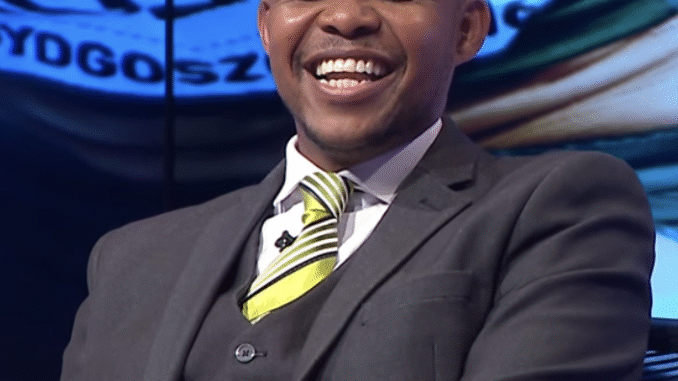
David Kekana was a South African sports broadcasting legend, as a respected analyst, pleasant human being, and passionate soccer lover. Kekana was born on November 2, 1971 and grew up to become a legendary SABC sports analyst, who changed the lives of millions of people until his unjust death on August 25, 2019, when he was only 47. He had a career life of close to twenty years, and in the course of that time, he turned sports commentary into a communication that was made reachable and informative to the audience throughout the country.

The legacy of Kekana is not just in broadcast but in the fact that he was a mentor, a teacher and an embodiment of commitment in a post-apartheid South Africa, and sought inspirational voices in the media. He not only excelled in his profession but also engaged the common South African in the process so that they felt they have been part of every analysis, every broadcast, and every talk of the beautiful game.
Kekana was born in 1971; his early life is rather a secret, but the history of his career proves that his background was based on discipline, education, and the community. He worked as a teacher of mathematics and English at JS Mpanza Primary School in Soweto, Diepkloef before joining sports journalism. Working in 1990s, a time of critical importance in the democratization of South Africa, could be seen as a way of working with a disadvantaged child and assist in shaping their educational and personal development.
This early teaching career sharpened some skills that would later on determine his style of broadcasting; clarity in communication, simplifying complex concepts, and the ease in relating with the people. These attributes made him be able to explain complex tactical interpretation in a manner that may be understood by even an ordinary soccer enthusiast. In the case of Kekana, there was a similarity in teaching and sports commentary in terms of the aim they had in educating and entertaining the audience.
Kekana started his journalism profession in 1999 with the Sunday times, a renowned South African paper. This early attraction to print journalism had sharpened his skills of research, writing, and telling stories. At the same time, he worked as a sports commentator at Primedia and M-Net (then SuperSport), which provided him with a multi-platform insight into South African sports media.
In 2000 he was taken to SABC Sport, which he would spend 18 years of his life in, becoming one of the chief football analysts. Kekana, who began in Soccerzone as a football analyst and scriptwriter, soon went on to do work on Soccer 411, Sportat10 and Laduma. His duties covered scriptwriting, research, and touchline presentation, and needed careful preparation and improvisation.
Kekana also had experience in big sporting events such as FIFA world cup, Olympic games, Africa cup of nations and All Africa games. His co-workers frequently complimented his knowledge of the sport, which was great, and his capacity to give the background to deepen the knowledge of the viewers. Their similar birthdate became a point of humor as former SABC colleague David O’Sullivan remarked, but also commented on Kekana and her commitment and mentoring with the camera and off.
In addition to broadcasting, Kekana also helped with the administration of soccer as Managing Director of Baroka Football Club and in the social cohesion programs in Gauteng Province. All these positions helped him underline that he thought sport would help bring communities together and promote dialogue, proving that his influence was far wider than media.
Colleagues referred to Kekana as a hardworking, humble, and never-endingly generous person as far as his knowledge is concerned. He was rigorous in his analysis and at the same time warm, humorous, and smiling which has become his trademark. His criticisms were never rude and his love and interest in good play was infectious. His presence was experienced by not only the broadcasters and players but also the viewers as an analyst but as a mentor, friend, and role model.
Kekana was not a distinguished person in terms of awards but impact. He had an outstanding professional consistency in his extended tenure at SABC sport, which was entrusted with taking care of global events such as the Olympics and World Cup. His work was highly rated by the society, as demonstrated by government recognition, appointment to social cohesion programs. Minister of Sport, Arts and Culture Nathi Mthethwa termed him as an old school analyst whose contribution to the growth of sports will be greatly missed.
His influence would not be limited to his career as his mentorship saw to it that he created a generation of South African sport analysts. The emotional offerings made by fans demonstrated the level of attachment that he had towards the masses, a level of love that awards and medals could never define.
Kekana was a parent to two daughters and a family man who had to juggle between the pressure of broadcasting and personal lives. He was humble, funny, and friendly; he had good relations with colleagues, players and audiences. The signs of his individual freedom and social progress were his marriage, in post-apartheid South Africa.
He had been fighting a chronic case of diabetes all his life, and that too survived, costing him his life at the Milpark Hospital in Johannesburg in August 2019. This notwithstanding, he persevered with his work, proving that he was a strong-willed and committed man to his profession.
Although no information is available on the actual net worth of Kekana, his career in the public broadcasting together with his involvement in football management gave him a steady, middle-class way of life. What he did was driven by his focus on the purpose over material accumulation: meaningful work, family and community impact were more important than the material one. His real success was determined by his generosity, mentorship and his professional integrity.
The death of David Kekana created a vacuum in the South African sports media. His legacy is in the way he brought the standards of sports analysis higher, mentoring the future broadcasters, social unification by sport and making professional skills available to regular South Africans. He demonstrated that knowledge, passion, humility and generosity man could make a significant and long-term impression.
The testimonials of government officials, colleagues and fans highlighted his influence as evidence of the fact that his life and work were beyond professional success. His career is a teacher to aspiring broadcasters on the importance of professionalism, communication, mentorship, and the strength of passion.
The impact Kekana had on the sports of South Africa will still be felt today not just in the study of football games, but in the many lives he influenced, the careers he molded and the spirit of togetherness that he brought about to people through the game he adored.