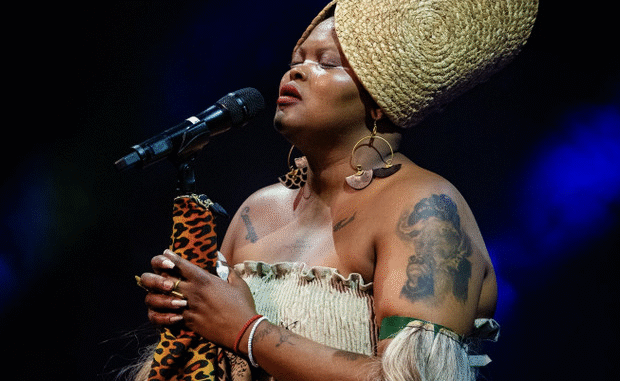
Buhlebendalo Mda otherwise referred to as Buhlebendalo is a South African singer, songwriter, spiritual creative, and activist whose voice and presence has made a strong impact on modern African music. Having been born in Soweto and being brought up in the cultural environment of the township and a traditional-based family, she had been surrounded by song, ritual and story. Her music is the identity, healing, and connection that she has been searching all her life through the specific combination of Afro-soul, folk, traditional Xhosa, spoken word and profound spiritual motives.
The artistic experience that has seen Buhlebendalo as a solo artist and one of the founding members of the award-winning acapella band The Soil is an unwillingness to follow the rulebook and the desire to make music that has something to say, something to remember, and something to change.
Buhlebendalo realized that she was attracted to music at the earliest age as an expression of self. In her family home, she experienced the swings of gospel choirs, traditional songs and the hectic sound of township life. She was greatly affected by the rhythms of African folk music, the improvisational spirit of township music, and the crude force of group singing. Her voice was mature and profound with feelings even before she started working.
The development of The Soil, an acapella band, which became nationally renowned due to its sound of kasi soul, which is a complicated combination of beatboxing, polyphonic harmonies, and sincere narration, was the turning point in the musical career of Buhlebendalo. Being one of the lead singers, she was well known by her strong contralto voice, soulful performance and her capability to embody both the sense of vulnerability and of strength at the same time. The success of the Soil made her shine in the national arena, where she toured the country selling out and receiving several awards, as well as touring internationally. Their music reached audiences of all ages, glorifying real life, love, spirituality and social commentary, with bare handed vocal arrangements.
As The Soil was gaining recognition as a legendary cultural movement, the personal artistic identity of Buhlebendalo was expanding and developing at the same time. She needed to venture into ideas and sound paths where she could have her own room, like womanhood, healing, sexuality, trauma, and ancestral connection. They were highly individualistic themes and she had a desire to explore them without the context of a group. This culminated into a natural drift to her own individual career where she started experimenting with a more grounded, earthy and experimental sound palette. Her solo compositions include live instrumentation, ritualistic qualities, soundscapes of indigenous origins, and poetic ruminations, which form a very intimate and spiritual experience of listening.
Her first solo album, which was created as a result of introspection and personal healing, marked a statement of bold art. The project incorporated African spirituality, wisdom of ancestors and the issues of being a black woman in South Africa today. Her music was no longer meant to entertain, but to awaken-to call on the audience to think, get rid of and come back to him/herself. The songs use the influences of Xhosa folk, Afro-soul, minimalism, and spiritual chants, bonded together by her unique memorable voice that is simultaneously rough and reserved. Her skills as a one- woman artist were confirmed by the critical acclaim of her album.
The voice of Buhlebendalo is one of her most remarkable peculiarities. It is emotional but smooth, emotionalized but not feelingsless, and able to depict both extreme vulnerability and strong self-confidence. Her voice is based on the traditional African singing, speaking, jazz phrasing, and chant-based ritual singing. She acts frequently in isiXhosa and English, language being one of the instruments of identity and freedom. Through her performance, her approach to delivery is not so technical but as much emotional and gives a sense of shared experience between artist and listener.
Her live shows are highly considered to be transformative. Buhlebendalo goes to the stage as a holy place of meeting of music, spirituality, and healing. She uses standard clothing, use of symbolic gestures, incense and ritual imagery to make the setting to be more of an experience than a simple performance. Every performance is a moment of encounter, the lines between performer and spectator vanish. To most of her fans, going to watch one of her shows is like going into a sanctuary, where music seems to be a way of letting out emotions and remembering culture.
In addition to music, Buhlebendalo is a vocal supporter of social issues, especially female, LGBTQ+, and marginalized ones. Her art is intertwined with her activism. In her songs and in her speech, she frequently speaks on the topics of gender-based violence, identity, cultural erasure, and mental health. Through her platform, she challenges detrimental norms, gives a voice to her survivors, and glorifies African identity. She has earned the respect of the arts community and even in social justice realms due to her authenticity and courage.
Her artistic self goes over to visual art, poetry, and rituals. Buhlebendalo perceives art as a whole calling, in which there are sound, image, movement, and spirit. Such multidimensional approach can be identified in her music videos that are frequently combined with symbolic imagery, African aesthetics and narration. She is purposeful in how she depicts the black body, traditional clothing, and indigenous ways of doing things with respect and sensitivity. Her poetry is a tribute to the ancestry but she is also involved in modern crusades and successes.
As she keeps growing, Buhlebendalo is determined to make art that is sincere, restorative, and that which is intensely tied with heritage. She belongs to a rising trend of South African artists rediscovering the native practices, languages, and spiritual philosophies in a new form. Her music can be characterized as the place where the traditional and the innovative meet and provide a sound that is stable and continuously changing. She has influenced the younger generations who want to be unashamed of their identity and create without the fear of going against the ways of industry.
Today, Buhlebendalo is one of the strong hearts of South African music, a woman whose voice is thunderous and gentle at the same time, whose art is situated between the visible and the invisible and whose work is grounded in healing, truth and cultural memory. Her music career as she went out of Soweto to international scenes is an epitome of perseverance, ambition and undeterred adherence to genuineness.
Songs
- Ukhamba
- Ulele Ubaba
- Ulele Ubaba (Conversation)
- Kakhulu (Conversation)
- Kakhulu
- Inqawe (Conversation)
- Inqawe (feat. Muzi)
- Isiduli (Conversation)
- Isiduli
- Isikhwama (Conversation)
- Isikhwama
- ZULU
- Inhlokomo
- Embo
- Cwaka (Acoustic)
- Iliso
- Ngiyesaba (feat. Sizwe Alakine, Priddy Ugly)
- Umzi Watsha
- Troubled Waters
- O bonolo
- Ndodakazi
- Mawawa
- Hele
- Umzi Watsha (Single)
- Too Late for Mama
- Umenzani
- Nethisa
- Ilanga (feat. Sjava)
- Salute
- Khuphuka (feat. Madala Kunene)
- Bayangihleka
- Buya Azania
- Nyamazane
- Vusela (feat. Mthetheleli Gongotha)
- Mdali
- Ntab’ezimnyama
- Iwotshi