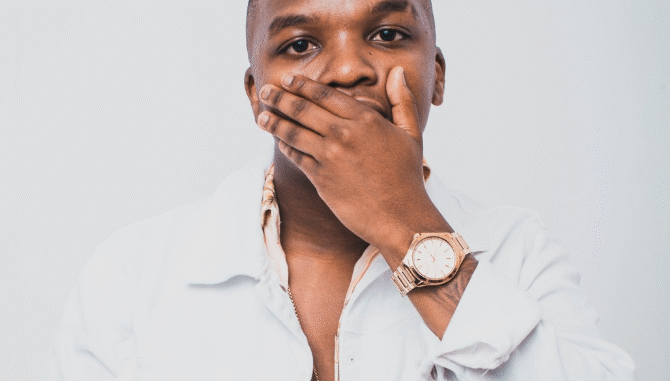
Dlala Thukzin (born Thuthuka Wandile Zindlovu) was brought up in Lamontville, a township in the South Coast of Durban, KwaZulu-Natal, South Africa. His childhood life exposed him to music in the family: when he was a boy his uncle used to move sound equipment to the DJs. At the age of his early teens he already attended local gigs and small clubs in Durban, and got acquainted with the basics of the DJing business and with the sense of rhythm, the sense of the drums, and the sense of the crowd-energy, which would prove as his defining ingredient in sound in the future.
His formal introduction into the music industry occurred in 2016 or so, when he provided production in one of the tracks of the debut album of a big Gqom artist. That contribution made him a producer to watch and set him next to the Durban-born Gqom movement, which offered him some credibility and visibility in a genre that was gaining ground all over the country. Since that time, Thukzin started gaining a reputation not only as a DJ, but as a well-rounded producer who can combine various genres: the raw and percussion-infused Gqom, edgy Afro-tech, and, as the music industry transformed, even Amapiano and the 3-step.
The most remarkable feature of Dlala Thukzin was the fact that he did not fit in one genre. Rather, he decided to make genre a palette – log-drums, heavy bass, electronic synths, dancefloor driving beats, melodic hooks.
His single titled Phuze became his landmark in the year 2021. Having a combination of profound drums, rhythmic grooves and features of voice, the song was a success, initially, it gained gold certification and its remix version of the song hit platinum. It generated a discussion around genre boundaries: some called it Afrohouse, some Gqom, or Amapiano – evidence that the music by Thukzin was defying conventional genre boundaries. Such power of erasing boundaries made it a core part of his persona: a musical pioneer who was at home crossing genres and generations.
Thukzin issued a number of projects in the following years which demonstrated his development and ambition. His Permanent Music series, which was done in several parts, enabled him to experiment with soundscapes, to collaborate with various partners, and to enlarge his production palette.
Song flew high – in a few hours it was dispersed in streaming platforms, and in a few seconds it was in charts. It topped several charts in South Africa, such as the national streaming chart and the radios of the area airplay charts, and was awarded twice-platinum. To a high number of listeners and industry observers, iPlan was not only a radio hit, but also a description of what contemporary South African music dance might sound like: not tied to a genre, but localized in rhythm, and universally attractive.
The success of iPlan was the turning point of Thukzin as he started rising as a DJ-producer to become a mainstream. One day his name was in the radio, in the clubs, on the streaming playlists and in discussions about the future of dance music in South Africa. It was successful to an extent that by 2025 he was featured in the leading platforms and playlists that are designed to present the latest electronic/Afro-tech music in Africa.
His credibility in the music production had extended by 2025. His influence expanded to make his own festival-like lineup and contribute back: organizing his own showcase of emergent artists in his home city of Durban and beyond. By so doing, he hoped to develop not only his own legacy but also the ecosystem – providing townships and small communities with an opportunity, the same way he had himself.
In the music, the style of Thukzin is characterized by versatility. He switches with éase between pounding drums and bass log, deep and atmospheric percussion and synths, melody, and rawness. His music has the power to induce euphoria and vitality on dancefloors, and at other moments bring an ambiance: philosophical, melancholy, at times depressed. The latter duality dance and depth is one of the elements that make him special.
At a personal level, the path that he followed as he carried sound boxes in Durban with his uncle, to world fame and platinum albums, is an example of perseverance, aspiration, and flexibility. It is a tale of a person who rose with a limited background but was able to nourish a dream, work on his trade in silence and grabbed his chance when it came.
As of 2025, he continues to evolve. His new projects indicate that he is not keen on using the same formula. Rather, he is experimenting even further: 3-step, Afro-tech, fusion tracks, cross-regional, cross-genre collaborations. His status is not merely that of artist, but rather in the form of curator, mentor, sound and culture designer.
Dlala Thukzin is somehow the symbol of a generation of the South African musicians who cannot be boxed. He is a representative of innovation – of a blend of conservatism and new-school vitality; of locally based rhythm and global coverage; of innovativeness that does not sacrifice to commercial common sense. By doing that he helps in the redefining of dance music in South Africa pushing its boundaries and broadening the possibilities.