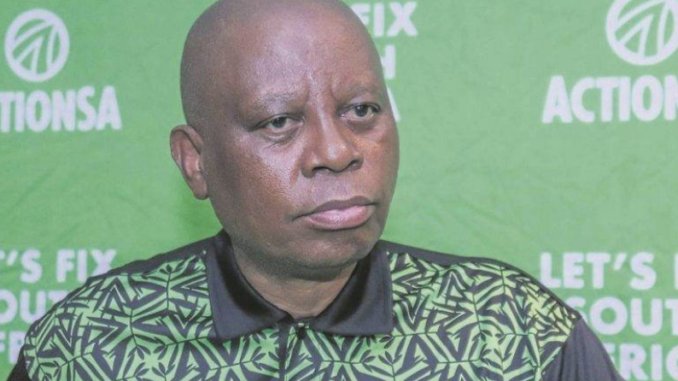
Herman Mashaba is one of South Africa’s most successful self-made businessmen turned politicians. He is the founder of the Black Like Me hair care empire, a former mayor of Johannesburg, and the leader of ActionSA, a political party he founded in 2020. Known for his stubbornness, blunt speaking, and determination, Mashaba has built a reputation as a man who gets things done. But he has also made enemies along the way, particularly within his former party, the Democratic Alliance (DA), and its former leader Helen Zille. At 66 years old, Mashaba is running again to be mayor of Johannesburg, a job he calls his “unfinished business.” This is his story.
Early Life and Humble Beginnings
Herman Samtseu Philip Mashaba was born on 26 August 1959 in Hammanskraal, north of Pretoria. He grew up in the GaRamotse area, where his family faced extreme poverty. His father died when Herman was only two years old. His mother worked as a domestic worker and was often away from home for long periods to support the family. The family did not have their own house. Instead, they lived in the homes of migrant workers while those workers were away.
Despite these difficult circumstances, Mashaba’s grandfather saw something special in him. The family called him “high man” because his grandfather predicted he would become someone important in society. Many years later, after apartheid ended, Mashaba officially adopted the name Herman, but people in his home village still call him “high man.”
Growing up, Mashaba knew the pain of hunger. He later recalled having to drink water to stave off hunger pains. He always believed that education was the key to success. He worked hard and was accepted at the University of the North, where he wanted to study for a Bachelor’s degree in public administration and political science. But his dream of earning a degree was shattered in his second year when circumstances forced him to drop out and start working.
The Birth of Black Like Me
Mashaba started his career at age 19. He was a salaried worker for only 30 months of his life because he did not like working for somebody else. He preferred to be his own boss. In 1982, he became a commission-only sales representative, selling various products from the boot of his Toyota Corolla.
In 1983, he began focusing on hair care products. While working as a door-to-door salesman selling hair products on commission, he conceived an idea. It took him 19 months to figure out what his employer was doing, and he decided he could do it on his own. He put together a team of like-minded South Africans and came up with a catchy name: Black Like Me. They had only R30,000 to start the business and no money for marketing.
On 14 February 1985, the first Black Like Me product hit the South African market. The timing was challenging. When Mashaba started his business, legislatively, as a black person, he could not own a business. South Africa still had pass laws and the Group Areas Act. There was also a state of emergency, which made business operations difficult. But Mashaba persevered.
The first factory was in GaRankuwa, with 100 employees manufacturing the products themselves. In 1989, he built his own factory in Mabopane Township. From there, the business grew into a multi-million-rand empire. Black Like Me became the most successful black hair care brand in South Africa.
Mashaba used celebrities as brand ambassadors, including Felicia Mabuza-Suttle, Wendy Luhabe, and Yvonne Chaka Chaka, who appeared on his first poster in the 1980s.
Entry into Politics
Mashaba was interested in politics from an early age. One of his happiest memories was being able to make his mark in South Africa’s first democratic elections in 1994. For many years, he remained an armchair critic, watching as the country struggled with corruption, poor service delivery, and failing infrastructure.
But over time, he decided to stop criticizing from the sidelines and take action. In 2016, he announced that he would stand as the Democratic Alliance’s mayoral candidate for Johannesburg. It was a bold move. The African National Congress (ANC) had controlled Johannesburg since 1994, and few believed the DA could win.
Mayor of Johannesburg (2016-2019)
Against all expectations, Mashaba won. He was elected Executive Mayor of Johannesburg in August 2016, leading a multi-party coalition government. It was the first time the ANC had lost control of the city since the end of apartheid.
Mashaba’s tenure as mayor is widely remembered as a period of stability and delivery, in stark contrast to the chaos that followed after he left. His achievements were numerous.
On infrastructure, Mashaba inherited 4,000 kilometres of broken roads and 700 crumbling bridges, with a backlog of R18 billion. He got to work immediately. He diverted money wasted on lavish travel, newspaper delivery, and vanity projects. In 2016/17, R88 million was reallocated towards road repairs. In just three years, 938 lane kilometres of road were repaired, and 88 kilometres of gravel roads in informal settlements were upgraded to surfaced roads. Nine hundred and two bridges were also maintained. In February 2019 alone, a new Jetpatcher system repaired over 2,700 potholes, nearly 200 potholes a day.
On crime and law enforcement, Mashaba launched a dedicated anti-corruption unit to clean up corruption within the city administration. The unit investigated over 6,000 cases of corruption, totalling more than R35 billion in transactions under investigation, and effected more than 900 arrests. He recruited 1,500 new JMPD trainees to strengthen law enforcement. The city launched its first K9 narcotics unit, Amabarret, aimed at fighting human trafficking and drug trafficking. Security officers were insourced from private security companies to become permanent city employees with proper wages.
On healthcare, Mashaba extended the operating hours of 26 clinics, saving more than 500 lives with after-hour care. He procured seven mobile clinics to provide primary healthcare to informal settlements. He also started five city-operated substance abuse facilities, the first in the city’s history.
On housing, his administration delivered 7,000 RDP homes, 7,500 title deeds, and 3,500 serviced stands.
On energy and water, Mashaba reduced power outages from 6.1 to 5.8 per annum during peak load shedding. He reduced water leaks and bursts from 45,000 to 37,000 per annum. He also built the largest electricity sub-station in the southern hemisphere within schedule and under budget.
Resident satisfaction reached 74%, the highest levels in the history of the city. He also achieved R17 billion in facilitated investment in 2018/19.
Mashaba’s approach to law and order was controversial in some quarters. He was known for his tough stance on illegal immigration, which he blamed for capturing Joburg’s inner city. But among law enforcement officers, he remained popular. A JMPD officer later praised Mashaba’s tenure, saying it restored law enforcement morale and strengthened the fight against crime, particularly in Soweto.
The Fallout with Helen Zille and Exit from the DA
Despite his successes, Mashaba’s relationship with the DA’s federal executive, particularly its leader Helen Zille, was deteriorating. Mashaba has spoken openly about his belief that the DA did not want him to serve poor black communities. He accused the party of not wanting to provide services in townships and black areas.
The breaking point came in 2019. Mashaba alleges that Zille secretly cut a deal with the ANC and orchestrated his removal as mayor. “Zille is the only woman in the world who can pass a lie detector test. Because she believes her lies,” Mashaba later told a journalist, his frustration evident.
On 21 October 2019, Mashaba resigned as mayor of Johannesburg and left the DA. He cited his irreconcilable differences with the party’s direction and leadership. His departure left Johannesburg in a state of political instability, with several mayors serving short terms in quick succession. Many observers view Mashaba’s term as the last relatively stable administration in the city’s recent history.
Founding ActionSA
In August 2020, Mashaba launched a new political party called ActionSA. The name reflected his belief that words and promises were not enough. Action was needed.
ActionSA’s vision was to build a party that would represent all South Africans, from rural communities and townships to urban centres. Mashaba invested heavily in this principle. He also donated R2 million of his own money to the party in May 2023.
The party grew steadily. Through its “Green Umbrella Project,” ActionSA merged with smaller community-rooted parties, expanding its reach. From 91 public representatives at launch, ActionSA grew to 141, and later to nearly 150. The party claimed its first by-election victory in Ward 7 in Ramotshere Moiloa Municipality in the North West in October 2025, unseating the ANC in a historic rural stronghold.
Challenges in the 2024 National Elections
ActionSA entered the 2024 national elections with high hopes, having built momentum since its founding. But the results were disappointing. The party received only 1.2% of the national vote, securing just six seats in Parliament.
In interviews after the election, Mashaba admitted to making mistakes. He said he had underestimated the popularity of former president Jacob Zuma and the influence of the newly formed MK party. “I honestly undermined and underestimated the influence of Jacob Zuma. I said, ‘No, this is not going to happen,'” he admitted.
More significantly, he acknowledged that he had not appreciated how deeply black voters distrust the DA. ActionSA had been part of the Multi-Party Charter, also known as the Moonshot Pact, which included the DA. Mashaba said voters told him they saw ActionSA as “DA light” and refused to vote for the party because of its association with the DA.
ActionSA eventually pulled out of the Multi-Party Charter, citing the DA’s “double dealings” and its consideration of a coalition with the ANC at the national level.
The 2026 Local Government Elections Campaign
In 2026, Mashaba announced he would run again for mayor of Johannesburg. His campaign is called “unfinished business.” He believes he has work to complete in the city he once led, and he wants to restore the stability and service delivery that Johannesburg has lost since his departure.
ActionSA has been positioning itself as a growing force. In January 2026, the party announced merger agreements with the Azanian Independent Community Movement and the Creatives Congress Movement, adding seven more councillors and expanding into the North West.
Mashaba has also introduced a comprehensive anti-corruption reform package, including the Zero Tolerance Corruption Bill, which seeks to introduce mandatory minimum sentences for corruption. “South Africa has reached a point where we have only two choices: we either defeat corruption or corruption will defeat South Africa,” he warned.
Shifting Political Messaging
An analysis of Mashaba’s social media messaging shows a marked evolution over time. In 2020, his stance on the ANC was unequivocal, repeatedly stating that the government had failed citizens. He consistently urged opposition parties to exclude the ANC from coalitions.
But after the 2024 national elections, his tone softened toward the ANC. By early 2025, Mashaba publicly praised a coalition involving the ANC, EFF, and ActionSA in Tshwane, saying it made him proud.
At the same time, his tone toward the DA hardened significantly. He declared the DA’s “moonshot pact is dead” and warned that a vote for the party could risk “apartheid in disguise.”
Mashaba has denied that ActionSA is working with the ANC in Johannesburg. He has said that he brought concerns to the ANC leadership and that ActionSA has since pulled out of arrangements where it felt contaminated.
Personal Life
Mashaba has been married to his wife, Connie, for over 35 years. They have two children: a daughter named Nkhensani and a son named Rhulani.
In a rare interview at his home in Atholl, Sandton, a journalist described the Mashaba home as a palatial setting within an exclusive, leafy estate. But the journalist noted that Mashaba earned it not through corruption or tenderpreneur capture. Mashaba is a self-made business tycoon, an astute one at that.
When asked why he continues in politics at age 66, having already made his fortune, Mashaba pointed to Alexandra, the sprawling township a stone’s throw from Sandton, where 700,000 residents live mostly in shacks. “How can I be comfortable knowing that down the road people are going hungry, people are going without water?” he asked.
Connie, his wife, was asked if she regrets his decision to go into politics. Her eyes flickered. She sighed, looked at Mashaba, and replied softly: “I’ve learnt to accept it. We live our lives – him in his political world and me in the business – and then we come together as a couple. We dance, we take time out, we travel and all that is our time. It works.”
When he is not working, Mashaba enjoys playing golf and tennis. He also plays the piano on occasion.
What Could Be Better
As a public figure, Herman Mashaba has several weaknesses that critics point to.
His shifting political alliances have raised questions about consistency. After spending years urging opposition parties to exclude the ANC from coalitions, he has since praised ANC-inclusive coalitions in Tshwane. This flip-flopping risks undermining his credibility as a principled leader.
His ongoing feud with Helen Zille, now years after leaving the DA, can seem obsessive. In a 2026 interview, a journalist asked him directly whether his campaign was more about settling scores with Zille or about fixing Johannesburg. He hesitated before answering, and his wife smiled knowingly.
His anti-immigrant rhetoric has been controversial. He has been vocal in blaming illegal foreign nationals for capturing Johannesburg’s inner city. Critics argue that this rhetoric fuels xenophobia, even if he insists he is only targeting undocumented immigrants.
His party, ActionSA, performed poorly in the 2024 national elections, securing only six seats. This raises questions about whether his message resonates beyond Johannesburg, or whether his fame is tied too closely to his mayoral tenure.
His admission that he underestimated Jacob Zuma’s influence also suggests a political blind spot. For a seasoned political operator, missing the rise of the MK party was a significant miscalculation.
Rating
As a public figure, Herman Mashaba receives a rating of 7 out of 10.
Herman Mashaba is a rare figure in South African politics: a self-made businessman who built a successful company from nothing, then transitioned into public service and achieved measurable results as mayor of Johannesburg. His record on fixing potholes, fighting corruption, improving healthcare access, and stabilising the city’s finances is documented and verifiable.
However, his shifting political positions, his bitter feuds with former allies, and his controversial stance on immigration have alienated some potential supporters. His party’s poor national performance in 2024 suggests that his appeal has limits.
But at 66, Mashaba is not slowing down. He is running again for mayor. He has unfinished business. And whether he wins or loses, he will continue to speak his mind, loudly and without apology.
Personal Assessment
Herman Mashaba is a stubborn man. He admits this himself. He said in a 2010 interview, “People who have interacted with me think I’m stubborn, but I think that means I have a strong character.”
That stubbornness served him well in business. It took him from selling products from the boot of a Toyota Corolla to building a multi-million-rand hair care empire. That same stubbornness served him well as mayor, where he pushed through reforms despite resistance from within his own coalition and from the city bureaucracy.
But stubbornness is a double-edged sword. It has also led to broken relationships, public feuds, and an inability to let go of grievances, particularly against Helen Zille. The journalist who interviewed him at his home observed that Zille’s mere name triggered him. Mashaba blames Zille for much of his woes, and he believes she is responsible for the mess in the city.
Mashaba is driven by success and a winning attitude. Behind the warm, affable persona is a man who thrives on order, success, and achieving his desired outcomes. For Mashaba, failure is not an option.
That is why he is running again. That is why, at 66, he refuses to retire to his palatial home in Sandton to play golf. He believes he can fix Johannesburg. And he has the record to prove that he did it before.
Whether he can do it again depends on the voters of Johannesburg. But one thing is certain: Herman Mashaba will not go quietly.
Conclusion
Herman Mashaba’s story is one of the most remarkable in modern South African history. He grew up drinking water to stave off hunger. He dropped out of university and built a business empire. He became mayor of Africa’s richest city and got things done. He fell out with his party, started his own movement, and is now fighting to return to office.
He is not a perfect politician. He is too stubborn, too blunt, and too willing to hold grudges. But he is also effective. The potholes he fixed are still fixed. The anti-corruption unit he created is still operating. The clinics he extended are still saving lives.
Mashaba once said he went into politics because he wanted to give young South Africans the same opportunities he had to make a success of themselves. That is his mission. That is his unfinished business. And at 66, he is not done yet.
FAQs About Herman Mashaba
Who is Herman Mashaba?
Answer: He is a South African businessman, the founder of Black Like Me hair products, a former mayor of Johannesburg, and the leader of ActionSA, a political party he founded in 2020.
When was he born?
Answer: He was born on 26 August 1959 in Hammanskraal, South Africa.
What is Black Like Me?
Answer: Black Like Me is a South African hair care brand that Mashaba founded on 14 February 1985. It became the most successful black hair brand in the country.
When was he mayor of Johannesburg?
Answer: He served as Executive Mayor of Johannesburg from August 2016 until his resignation in October 2019.
Why did he leave the DA?
Answer: He cited irreconcilable differences with the party, particularly with its leadership and what he perceived as its failure to serve poor black communities. He has also publicly blamed Helen Zille for orchestrating his removal as mayor.
What is ActionSA?
Answer: ActionSA is a political party founded by Mashaba in August 2020. It focuses on service delivery, anti-corruption, and providing an alternative to both the ANC and the DA.
How did ActionSA perform in the 2024 elections?
Answer: ActionSA received 1.2% of the national vote, securing six seats in Parliament. Mashaba admitted the result was disappointing and attributed it to underestimating Jacob Zuma’s influence and black voters’ distrust of the DA.
Is he married?
Answer: Yes. He has been married to Connie Mashaba for over 35 years. They have two children, Nkhensani and Rhulani.
What is his educational background?
Answer: He studied public administration and political science at the University of the North but dropped out in his second year due to financial circumstances.
What is he known for as mayor?
Answer: He is known for fixing potholes, fighting corruption, insourcing security guards, extending clinic hours, recruiting new JMPD officers, and bringing political stability to Johannesburg during his tenure.