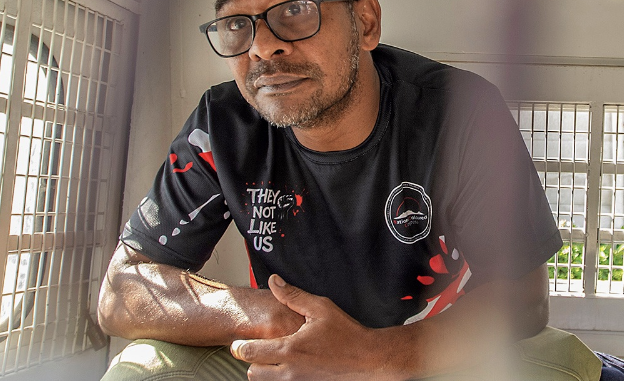
Fadiel Adams is one of South Africa’s most controversial and unconventional politicians. He is the founder and president of the National Coloured Congress (NCC) and has been a Member of the National Assembly since June 2024. His journey from a homeless, drug-addicted gangster to a national parliamentarian is extraordinary. However, his career has also been marked by legal troubles, ethics violations, and inflammatory rhetoric. Adams represents a voice of deep frustration for many Coloured South Africans who feel marginalised, but his methods have attracted as much criticism as support.
Early Life and the Road to Rock Bottom
Fadiel Adams was born on June 14, 1976. He was the third of six children in a working-class family in Lavender Hill on the Cape Flats. His father was a builder consumed by anger over apartheid-era forced removals that had displaced the family from Constantia, and his mother was a seamstress. Growing up in Lavender Hill, a community known for gang violence, Adams was surrounded by crime. His uncle was a “general” in the notorious 26s gang.
Young Adams sought respect on the streets. He dropped out of school in Grade 11 and fell deep into gangsterism and drug abuse. He later described himself as a “shooter” during his youth. By the age of 30, his life had completely unraveled. He was homeless, addicted to drugs, and saw no future for himself.
Turning Point and Redemption
Adams credits attorney Raybin Windvogel with saving his life. Windvogel helped him get off on some criminal cases and convinced him that he was destroying his future. Adams decided to turn his life around. He got clean, learned a trade, and began working as a tiler and plumber to support himself and his family. He married and had four children. For a time, he ran a small construction business and lived a normal, crime-free life.
The Accidental Politician
Adams’ entry into politics was sudden and unplanned. It came during the 2018 Siqalo riots in Mitchells Plain, a protest over land and service delivery that turned violent. Adams found himself in the middle of the chaos, which he later described as a “war zone.” In the confusion, he lost his car keys. He called his brother to bring spare keys, but police arrested his brother instead.
Frustrated, Adams went looking for his brother. The next day, he gave a 90-second interview to a journalist. The interview went viral, and Adams suddenly became a public figure. He was invited to community meetings and protests. Eventually, he decided to close his small business and dedicate himself full-time to activism.
In June 2018, Adams co-founded an organisation called “Gatvol Capetonian.” “Gatvol” is an Afrikaans term meaning “fed up to the point of vomiting.” The group gave voice to a growing sentiment among Coloured communities in the Western Cape who felt marginalised by Black Economic Empowerment (BEE) policies, neglected by the ANC-led national government, and ignored by the DA-led provincial government. They demanded better service delivery, an end to gang violence, and economic opportunities for Coloured people.
Founding the National Coloured Congress
In 2020, Adams transformed his movement into a political party. He initially founded the Cape Coloured Congress (CCC) and was elected to the Cape Town City Council in the 2021 municipal elections. In 2023, the party rebranded as the National Coloured Congress (NCC), signaling its ambition to contest national elections.
The party’s platform was simple and direct: fight for the rights of Coloured South Africans. Adams argued that his community was being left behind, that affirmative action policies were excluding Coloured youth from jobs and education, and that the government was flooding the ghettos with guns and drugs. He presented himself as the authentic voice of the “ordinary, gatvol coloured.” He famously said he was proud to be “the only man in this country to have built a political party wearing cuffed pants and slippers and getting it to parliament.”
Member of Parliament
In the 2024 South African general election, the NCC won two seats in the National Assembly. Adams was sworn in as an MP on 14 June 2024, his 48th birthday.
Once in Parliament, Adams continued his aggressive approach. He used his platform to attack the ANC for allegedly “marginalising coloured people” and the DA for poor service delivery in the Western Cape. He raised his profile sharply, often speaking on issues of police corruption and crime.
Controversies and Legal Battles
Adams’ political career has been inseparable from controversy. His combative style has repeatedly landed him in legal and ethical trouble.
Hate Speech Finding: In 2023, the South African Equality Court found that Adams had made racially offensive remarks about the City of Cape Town Manager, Lungelo Mbandazayo, on Facebook Live. The court ruled his comments constituted unfair discrimination, hate speech, and harassment. He was ordered to apologise.
Parliamentary Sanctions: In July 2025, the Joint Committee on Ethics and Members’ Interests found Adams guilty of breaching Parliament’s ethics code. He had shared a nine-minute video on Facebook in which he made derogatory remarks about the Mayor of Cape Town, Geordin Hill-Lewis, a female DA member, and the DA as a party. The committee recommended that he be reprimanded, suspended from parliament for 15 days, and have his salary docked for that period.
Feud with Police Leadership: Adams has engaged in a bitter public feud with KwaZulu-Natal Police Commissioner Nhlanhla Mkhwanazi. Mkhwanazi accused Adams of improperly handling confidential Crime Intelligence information and using it to lay criminal charges against senior police officers. Adams, in turn, accused Mkhwanazi of corruption and running away from duty.
Fraud and Obstruction of Justice Charges: In May 2026, Adams was arrested at his parliamentary village home in Cape Town. The arrest followed a warrant issued in connection with the 2017 murder of ANC Youth League leader Sindiso Magaqa. Police alleged that Adams had interfered with a convicted hitman at a critical stage of the investigation, amounting to fraud and defeating the ends of justice.
Adams claimed he was willing to cooperate but had requested that the Political Killings Task Team (PKTT) not be sent to his home. He alleged that officers had previously raided the wrong house, pointing firearms at a woman and assaulting a 12-year-old boy. At the time of his arrest, he told reporters, “I’m not scared, and I’m coming. If I survive this night, you and I are going to dance.”
Personal Life and Personality
Adams is a father of four children. He has been open about the toll his political career has taken on his family. In an interview, he admitted, “I’m a terrible father and an even worse husband because of the demands on my time. I’m never at home, and I don’t think they know me anymore.”
Despite his controversies, those who know him describe him as charismatic, streetwise, and deeply committed to his community. He has refused to wear suits and ties, often appearing in casual clothes to signal that he is not part of the political elite.
What Could Be Better
As a political leader, Adams has several weaknesses that critics point to.
His confrontational style, while popular with his base, has alienated potential allies and led to ethics violations that have embarrassed his party. His lack of formal political experience has shown in his repeated clashes with parliamentary rules and legal authorities.
The NCC remains a small party with limited organisational capacity outside of the Western Cape. It is heavily dependent on Adams’ personal charisma and has not yet developed a deep bench of leaders or a clear policy platform beyond representing Coloured interests.
The fraud charges against him, regardless of their outcome, have raised questions about his judgment and could damage his political future if he is convicted.
Rating
As a political figure: 6 out of 10
Adams is an effective advocate for a marginalised community. He has successfully brought grievances to the national stage that larger parties have ignored. His personal story of redemption is inspiring, and his authenticity resonates with voters who feel abandoned by mainstream politics.
However, his legal troubles, ethics violations, and inflammatory rhetoric undermine his effectiveness. He has not yet proven that he can translate outrage into constructive policy change. For his supporters, he is a hero. For his critics, he is a dangerous populist.
Conclusion
Fadiel Adams went from gangster and drug addict to homeless labourer to Member of Parliament. That journey alone is remarkable. He built a political party from nothing and forced the establishment to pay attention to a community it had long taken for granted. But his career has been a rollercoaster of highs and lows. The same aggression that propelled him into Parliament has also landed him in court and before ethics committees. As he faces serious criminal charges, the future of both Fadiel Adams and the National Coloured Congress hangs in the balance.
FAQs About Fadiel Adams
1. Who is Fadiel Adams? He is a South African politician, the founder and president of the National Coloured Congress (NCC), and a Member of Parliament.
2. When was Fadiel Adams born? He was born on June 14, 1976.
3. What is the National Coloured Congress? It is a political party founded by Adams in 2020, originally called the Cape Coloured Congress. It focuses on issues affecting Coloured South Africans.
4. What does “Gatvol” mean? It is an Afrikaans term meaning “fed up.” Adams co-founded the Gatvol Capetonian movement in 2018.
5. What were his early struggles? He dropped out of school, was involved in gangsterism, struggled with drug addiction, and was homeless by age 30.
6. When did he become an MP? He was sworn in on June 14, 2024, following the 2024 general election.
7. Has he been in legal trouble? Yes. He has faced hate speech findings, parliamentary ethics sanctions, and was arrested in May 2026 on fraud and obstruction of justice charges related to the Sindiso Magaqa murder investigation.
8. What are his main political views? He argues that Coloured South Africans have been marginalised by BEE policies, neglected by the ANC, and ignored by the DA. He advocates for economic opportunities and better service delivery for Coloured communities.
9. Is he married? Yes, he is married and has four children. He has described himself as a “terrible father” due to the demands of politics.