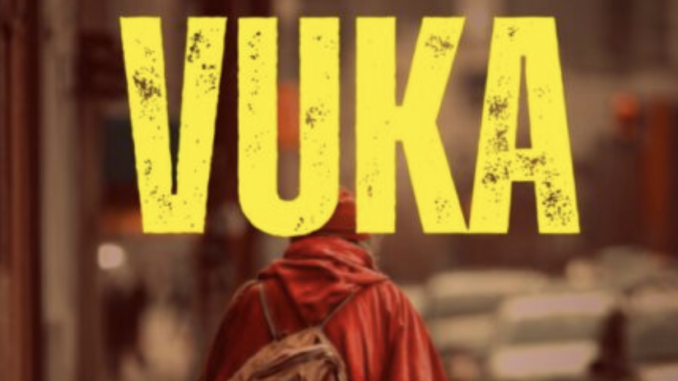
Vuka is a strong Nguni word that is normally translated to mean, to rise or to wake up. It brings emotional, spiritual, political, and motivational tones in South African music. The word is an indicator of movement whether it is in gospel, gqom, amapiano, or Afro-house. It is a call to action. A call to awareness. A call to elevation.
A list of those ten prominent songs containing the word Vuka in the title, explanations of the songs and brief biographies of the artists below.
Black Motion
Black Motion are a globally renowned Afro-house duo consisting of Thabo Mabogwane better known as Smol and Bongani Mohosana better known as Murdah. They popularized the South African house music worldwide by being known to incorporate live percussion with electronic production.
Their musical piece Vuka is spiritual and cinematic. The creation is slowly built up with drums, chants, and melodic textures. Vuka turns into a call to action and a spiritual enlightenment. It portrays the Black Motion style of signature- African rhythm with a world-touched polish.
DJ Tira
DJ Tira is among the most successful DJs in Durban and one of the central people behind the gqom popularization. Being the founder of the Afrotainment, he has influenced careers and sounds of genres.
His interpretation of Vuka is towards high-energy dances. The song employs the repetitive chants of the vocals on the top of percussion. Here, Vuka is a hype signal to the audience – wake up, move, act.
Heavy-K
The Drumboss as he is commonly referred to as Heavy-K, is known to create Afro-house hits that are based on heavy percussion and heartfelt lyrics. He combines both the old African aspect with the new commercial availability.
The drums come out in the limelight in his version of Vuka. The track feels ceremonial. The meaning of vuka means spiritual activation, which equates body and rhythm.
Kabza De Small
Kabza De Small is considered to be the King of Amapiano. His impact on the genre is titanic, and his projects were number one in the charts and his world tours.
At an amapiano club, the sound of Vuka would be less sharp and groove-like. The log drum beats continuously and the phrase itself drifts across rich chords. There is no urgency, only gradual awakening – something more of sunrise than alarm clock.
Dladla Mshunqisi
Dladla Mshunqisi is a combination of gqom, Afro-pop, and an energetic performance. Being known as humorous, but catchy in delivery, he still has good relations with the dance culture of Durban.
His Vuka is a personality. The line is light-hearted yet aggressive. It invites the audience to get on their feet and join in making the dancefloor a collective area.
Zahara
Zahara was an afro-soul who had many songs that were emotional and social commentary. Her style was quite acoustic and different to the electronic genre.
In the understanding of her, “Vuka” is inclined to emotional awakening. The song is close and introspective. Vuka is transformed as an invitation to individual transformation instead of club power.
DJ Maphorisa
DJ Maphorisa is a multi-genre producer that has produced gqom, amapiano and Afro-pop. His projects range between the local celebrities to the international ones.
His interpretation of Vuka usually blends the bounce of amapiano and hip hop flavor. It is rhythmic punctuation the short sharp, catchy word.
Professor
Professor incorporates kwaito and Afro-pop in their songs, and thus produces radio-friendly dance hits.
In his adaptation, Vuka is a part of the celebrations. It is not as serious and more cheerful, making awakening a joyful process.
Caiiro
One of the best known productions of Caiiro is deep house and Afro-tech-productions that are spiritual and atmospheric.
His interpretation would be a transformation of Vuka into mantra. The repetition is hypnotical and it gradually gains strength to the point of the drop being transcendent.
Mr Thela
Mr Thela is a giant gqom producer who infuses his music with refined aggression. His music tends to be indicative of the rough Durban dance culture.
Vuka is desperate in gqom form. Dark basslines and sharp kicks are intense. In this case, wakening is not a kindly thing–it is a violent one.
Related Artists
A number of other South African artists work in the same rhythmic empowerment and spirituality message areas. Black Coffee is still making Afro-house global. Mobi Dixon incorporates gospel and house sounds. Sun-EL Musician adds a melodic element to Afro-electronic. Shimza connects between underground house and festival stages. De Mthuda takes amapiano a step further. Focalistic is a blend of rap and piano bounce. NaakMusiQ is a mixture of Afro-pop and dance. Busiswa provides vocals which are commanding in electronic music. Prince Kaybee moulds radio friendly Afro-house. Gqom has an energetic advantage, which is perpetuated by Destruction Boyz.
The Meaning of the Title
Vuka is also translated to mean awake up or rise. In music however, it has various meanings. This may be the spiritual awakening, the political awakening, the personal awakening or it may be the simple awakening of just simply getting up and dancing.
It is a beautiful word since it is active. It demands response. In gospel it may refer to increasing in faith. In gqom, it is getting the people pumped. In amapiano, it can be a representation of emotional upliftment.
It is very simple and as a result powerful. One word. Immediate impact.
Challenges
A word as banal and strong as Vuka is a charged and creative word to use. The artists have to distinguish their interpretation. The title would be generic without both excellent production or narration.
Then there is the issue of cultural subtlety. Vuka has layers in the Nguni languages. Its multiple-layered meaning can be whittled down to a catchy hook when it is exported in the world market. Artists have to juggle between accessibility and authenticity.
Why the Title
The reason why Vuka works is its universality but locality. Everybody knows about the idea of rising. But in the case of South Africa, the word has a particular linguistic and cultural familiarity.
Competitive streaming environment In competitive streaming space, strong and short titles shine. “Vuka” is memorable. It is chant-friendly. It can be translated with a variety of genres. That multipurposeness is the reason why so many artists come back to it.
The Future
The future of Vuka in the South African music is reinvention. The word might also be re-interpreted by the producers, through new sonic prisms, as genres keep on blurring- Afro-tech, 3-step, experimental amapiano.
Live music might provide a richness. Choral arrangements would rejoin it to the traditional spirituality. Electronic manufacturers can pursue more religious, filmic expressions among foreign consumers.
The African dance music is becoming popular across the world. Such words as “Vuka” are also travelling well since they sound rhythmic even prior to translation. If differences are told well and there is innovation in production, future music tracks named as Vuka may end up ringing well beyond South Africa.